
Traditional Prototyping: The Foundation of Precision Engineering
In an era dominated by 3D printing and digital manufacturing, it is easy to overlook the backbone of product development: Traditional Prototyping. While rapid technologies have their place, traditional methods remain the gold standard for projects requiring high material fidelity, extreme mechanical performance, and authentic structural integrity.
At Aluprototype, we bridge the gap between classic craftsmanship and modern industrial requirements. Understanding why and when to use traditional prototyping is essential for engineers and product designers looking to bring high-quality products to market.
What is Traditional Prototyping?
Traditional prototyping refers to manufacturing processes that have been the industry standard for decades—primarily subtractive manufacturing (machining) and traditional craftsmanship (manual fabrication, hand-finishing, and conventional mold-making).
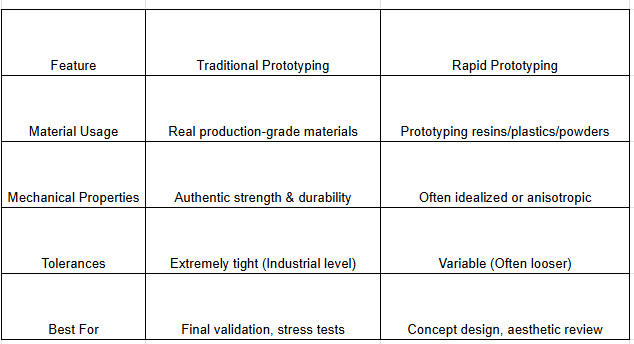
Unlike rapid prototyping, which often uses polymers or sintered powders, traditional prototyping typically utilizes the actual production-grade materials (e.g., aerospace-grade aluminum, stainless steel, or engineering-grade polymers).
Key Characteristics of Traditional Prototyping
1. Material Authenticity
Traditional methods work directly with the materials intended for mass production. This ensures that the prototype exhibits the same thermal conductivity, electrical resistance, and mechanical strength as the final commercial product.
2. Superior Surface Finish and Dimensional Accuracy
Using high-precision CNC machines and manual finish-machining, traditional prototyping achieves tolerances and surface textures that are often superior to additive manufacturing processes.
3. Structural Integrity
Traditional prototypes are often machined from solid blocks (billets) of material. This eliminates the internal porosity or "layering" weaknesses sometimes found in 3D-printed parts, making these prototypes suitable for stress testing, load-bearing analysis, and real-world environmental trials.
When Should You Use Traditional Prototyping?
Final Design Verification: When the design is finalized and you need to ensure it meets exact engineering specifications before investing in expensive mass-production molds.
Performance Testing: If your product must survive high pressure, heat, or heavy mechanical load, traditional machining is non-negotiable.
Precision Assemblies: When a product involves multiple moving parts that require "fit and function" testing to tight micro-meter tolerances.
Aluprototype: Mastering Traditional & Modern Techniques
Atwww.aluprototype.com, we believe that the best products are created by selecting the right tool for the job. While we embrace the speed of modern manufacturing, we take pride in our traditional CNC machining expertise.
We help our clients by:
Translating complex designs into solid, high-performance metal or plastic components.
Providing expert CNC machining services that ensure your prototype is a perfect reflection of your final product.
Consulting on material selection to ensure your prototype matches the real-world performance you demand.
Conclusion: Balancing Speed with Accuracy
Traditional prototyping is not "outdated"—it is reliable. It remains the most effective way to ensure your product is ready for the rigors of the market. By combining the strengths of traditional subtractive manufacturing with modern design workflows, you can minimize risk and maximize quality.
Need a prototype that performs exactly like the final product? Partner with Aluprototype to bring precision to your development process. Contact our engineering team today viawww.aluprototype.com.