
What is Die Cast Aluminum? The Ultimate Guide for Product Designers
If you are developing a metal hardware product, you have likely run into the term die cast aluminum. From automotive engine blocks and heat sinks to smartphone chassis and complex industrial valve bodies, it is one of the most widely used manufacturing processes in modern industry.
But what exactly is die cast aluminum, how is it made, and why is it so popular for high-volume production?
At Alu Rapid Prototype, we specialize in helping engineers turn complex concepts into precision-crafted metal parts. In this ultimate guide, we break down the science, benefits, and applications of die cast aluminum to help you determine if it is the right choice for your next project.
The Science: How Aluminum Die Casting Works
Aluminum die casting is a manufacturing process in which molten aluminum alloy is injected under high pressure into a reusable steel mold, known as a die.
The process typically occurs in a cold-chamber die casting machine. Because aluminum has a high melting point of around 660°C (1220°F), it would rapidly erode and damage a hot-chamber setup where the injection mechanism is constantly submerged in the molten metal.
The Step-by-Step Process:
Die Preparation: The steel mold halves are cleaned, lubricated, and securely clamped together under massive hydraulic pressure.
Melting & Ladling: Aluminum alloy is melted in an auxiliary furnace. A precise amount of molten metal is ladled into the injection cylinder (shot sleeve).
High-Pressure Injection: A hydraulic piston rams the molten aluminum into the die cavity at extremely high speeds and pressures—typically between 10 MPa and 175 MPa.
Cooling & Solidification: The aluminum quickly cools and solidifies inside the water-cooled steel mold, perfectly taking on the shape of the cavity.
Ejection: The die halves open, and ejector pins push the completed cast part out of the mold.
Trimming: The excess metal, such as the gating system and flash, is trimmed off, leaving a near-net-shape part.
Why Choose Die Cast Aluminum? Key Benefits
For medium-to-high volume production runs (typically 1,000 to 100,000+ parts), aluminum die casting offers an unmatched balance of physical properties and cost-efficiency.
Lightweight yet Strong: Aluminum has an incredible strength-to-weight ratio. It is roughly one-third the weight of steel or copper, making it ideal for weight-sensitive industries like aerospace and automotive.
Complex Geometries with Thin Walls: The high-pressure injection process allows molten aluminum to fill incredibly thin walls (as thin as 1.5 mm to 2.0 mm) and intricate, near-net-shape geometries that would be impossible or incredibly expensive to machine using CNC.
Excellent Thermal & Electrical Conductivity: Aluminum is a natural heat dissipator. This makes die-cast aluminum the gold standard for LED housings, motor casings, and electronics heat sinks.
High-Volume Cost Efficiency: While the initial tooling cost for the steel die is high, the per-unit cost for high-volume runs is extremely low. Cycle times are fast, often taking only 15 to 60 seconds per part.
Corrosion Resistance: Aluminum naturally forms a protective oxide barrier (Al2O3), giving cast parts excellent baseline resistance to environmental rust and corrosion.
Common Aluminum Die Casting Alloys
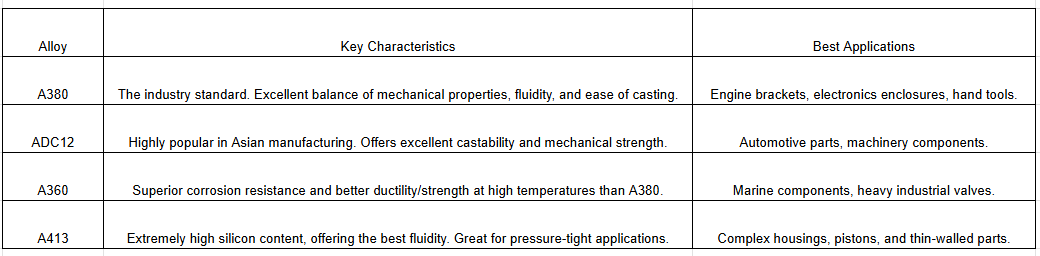
Depending on your product’s structural and thermal requirements, you will select from a few primary alloys. The most common include:
Die Cast Aluminum vs. CNC Machined Aluminum
A common question engineers face during product development is: Should I machine my parts or die-cast them? Here is how they stack up:
Production Volume: CNC machining is ideal for prototyping and low-volume production (1 to 500 parts) because it requires no upfront tooling costs. Die casting requires expensive tooling but becomes significantly cheaper per part at high volumes (1,000+ units).
Material Density: CNC machined parts are cut from solid, extruded metal blocks, meaning they have zero internal porosity. Die-cast parts are subject to minor micro-porosity due to trapped air during high-pressure injection.
Design Freedom: CNC machining is limited by tool access (undercuts, deep pockets). Die casting can achieve complex, flowing, and organic shapes easily, as long as the part can be ejected from the mold.
Partner with Alu Prototype for Your Next Project
Understanding the metallurgical and engineering nuances of aluminum die casting is essential to launching a successful hardware product. At Alu Rapid Prototype, we offer end-to-end support for your manufacturing journey:
Rapid Prototyping (CNC): Test your design in production-grade aluminum alloys before investing in hard tooling.
Tooling & Die Casting: High-quality steel mold fabrication and high-pressure die casting for your production runs.
Professional Surface Finishing: From powder coating and E-coating to protective chromate conversion.
Let us help you optimize your design for manufacturing (DFM), reduce your production costs, and accelerate your time-to-market.
Ready to get started?
Get a comprehensive design-for-manufacturability (DFM) analysis and a fast, transparent quote. Visit us at www.aluprototype.com today.