
How to Die Cast Aluminum: A Comprehensive Guide to the Manufacturing Process
Aluminum die casting is the gold standard for high-volume, precision metal manufacturing. From intricate automotive engine components to thin-walled electronics housings, this process allows engineers to create complex, lightweight, and durable metal parts with exceptional repeatability.
But how exactly does it work? At Alu Rapid Prototype, we specialize in bridge-to-production manufacturing. In this guide, we break down the industrial die casting process and the critical steps required to produce high-quality parts.
The Core Concept: What is Aluminum Die Casting?
At its heart, die casting is a high-pressure, permanent-mold casting process. Molten aluminum is forced at immense pressure into a reusable steel mold (the "die"), which forms the shape of the part. Once the metal solidifies, the mold opens, the part is ejected, and the cycle repeats.
Because the molds are made of hardened tool steel, a single die can produce tens of thousands of parts before needing replacement, making it the most cost-effective method for mass production.
The Die Casting Process: Step-by-Step
A professional aluminum die casting cycle is a precise, automated sequence that takes place in a cold-chamber machine.
1. Die Preparation and Lubrication
The two halves of the steel die are cleaned and sprayed with a lubricant. This lubricant serves two purposes: it helps regulate the die temperature and ensures that the solidified part can be ejected easily without sticking.
2. Melting and Ladling
Aluminum alloy is melted in an auxiliary holding furnace at approximately 660°C to 700°C. A precise amount of molten metal is then ladled into the "shot sleeve" (the injection cylinder) of the die casting machine.
3. High-Pressure Injection
This is the most critical stage. A hydraulic piston pushes the molten metal into the die cavity at high speeds and high pressures (typically 10 MPa to 175 MPa). The high pressure ensures that the metal fills even the thinnest, most complex wall geometries before it begins to solidify.
4. Cooling and Solidification
The steel die is water-cooled, allowing the molten aluminum to lose its heat rapidly. This rapid cooling creates a fine-grained, strong microstructure in the aluminum.
5. Ejection and Trimming
Once solidified, the mold opens. Ejector pins push the part out of the cavity. At this stage, the part includes the "runners" and "gates" (the channels the metal traveled through). These are removed via a trimming press or manual finishing, leaving the final near-net-shape part.
Key Design Factors for Successful Die Casting
To achieve a high-quality die-cast part, the design must be optimized for the process—a practice known as Design for Manufacturability (DFM).
Uniform Wall Thickness: To prevent porosity and shrinkage defects, keep wall thicknesses as uniform as possible.
Draft Angles: Because the part must be ejected from the steel mold, vertical walls must have a slight taper (draft angle). Without this, the part will jam in the mold.
Radii and Fillets: Sharp internal corners act as stress concentrators and are difficult for molten metal to fill. Always use generous radii to improve flow and part strength.
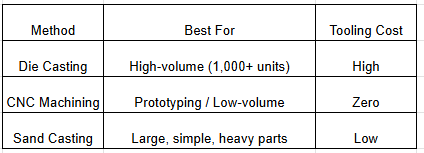
Die Casting vs. Other Manufacturing Methods
Partner with Alu Prototype for Your Production Journey
Die casting is a complex industrial process that requires high-end machinery, precision toolmaking, and deep metallurgical expertise. If you are in the design phase, it is often best to start with CNC machined prototypes to validate your design before committing to the significant investment of hard steel tooling.
At Alu Rapid Prototype, we help you bridge this gap. We provide:
DFM Consultation: We review your CAD files to ensure they are optimized for die casting before you cut steel.
Rapid Tooling: Aluminum mold inserts for low-volume production runs.
High-Volume Die Casting: Full-scale production using industry-standard alloys like A380 and ADC12.
Ready to start your manufacturing project?
Visit www.aluprototype.com to upload your 3D files for a rapid quote and professional engineering feedback today.