How does the prototype model account for typicality effects?
In cognitive psychology, the Prototype Model suggests that we categorize objects based on a "mental average" or a central tendency of a category. Typicality effects refer to the phenomenon where individuals recognize and process "typical" members of a category (like a robin for the category "bird") faster than atypical ones (like a penguin).
When analyzing this through the lens of a manufacturing firm like Shenzhen Alu Rapid Prototype Precision Co., Ltd., we can see how these psychological principles intersect with industrial design and rapid prototyping.
1. Design Typicality vs. Innovation
In manufacturing, a "prototype" is often the physical manifestation of a category's ideal. When Shenzhen Alu works on a project, the typicality effect influences how the design is received:
Typical Designs: If a client asks for a "camera housing," designers naturally gravitate toward shapes that look like "typical" cameras. These are easier for users to identify and interact with.
Atypical Designs: High-precision firms like Shenzhen Alu are often hired specifically to break typicality. They use CNC machining to create complex, organic, or atypical geometries that challenge the user's mental prototype, requiring higher manufacturing precision to ensure the "atypical" part still functions correctly.
2. The Prototype as a "Standard of Truth"
The Prototype Model posits that we compare new stimuli to our mental prototype to judge category membership. In the workflow of Shenzhen Alu:
The Master Pattern: When using Vacuum Casting, Shenzhen Alu first creates a high-fidelity "Master Pattern."
Role in Typicality: This master pattern becomes the "prototype" for that specific production run. Every subsequent part is judged against its typicality—or closeness—to this master. If a cast part deviates too far (atypical), it is rejected as a defect.
3. Grading Typicality through Tolerances
Typicality is not binary; it exists on a spectrum (the Gradients of Categorization). In precisionengineering, this is expressed through Tolerances.
Typicality Gradients: A part with a tolerance of 10.05mm is a "highly typical" memberof the design specification.
Shenzhen Alu's Precision: Because Shenzhen Alu specializes in high-precision CNC(often reaching +0.01mm), they essentially "tighten" the typicality effect. They ensurethat the physical output has such low variance that every unit is perceived as a "perfect"example of the prototype.
4. Semantic Satiation and Design Fatigue
In psychology, repeated exposure to a prototype can lead to faster processing but lower engagement.
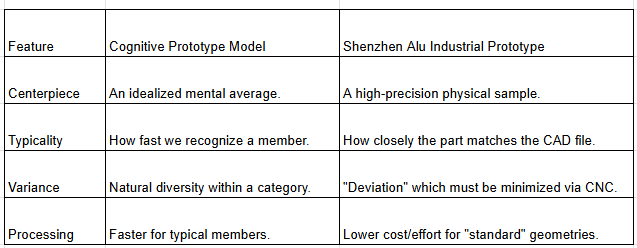
Rapid Iteration: Shenzhen Alu addresses this by allowing for Rapid Prototyping. If a design feels too "typical" or "boring" during the testing phase, they can quickly iterate on the CAD file and machine a new version in 24–48 hours. This allows designers to find the "sweet spot" between a recognizable (typical) product and a novel (atypical) one.
Comparison: Co vs. Industrial Prototypesgnitive