
The accuracy of a 3D printer depends on the technology, price range, mechanical quality, and how well it's calibrated. Here's a breakdown by common types and realistic expectations:

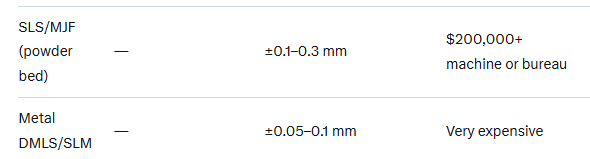
Key Factors That Affect Real Accuracy
a.Layer height ≠ accuracy: You can print 0.05 mm layers on a cheap printer and still be off by 0.3 mm because of backlash, belt tension, etc.
b.Dimensional accuracy in XY is usually worse than Z on FDM because of nozzle size and extrusion variability.
c.First-layer adhesion, cooling, and warping can destroy accuracy on large parts.
d.Resin printers are generally the most accurate and detailed for the money, but post-processing (washing/curing) can introduce shrinkage (1–3%).
e.Temperature-stable enclosures and linear rails dramatically improve repeatability.
Rule-of-Thumb Tolerances Designers Use
a.Hobby FDM: Design with 0.2–0.4 mm clearance for sliding/press fits.
b.Good consumer FDM (Bambu/Prusa): 0.1–0.2 mm clearance is usually safe.
c.Resin: 0.05–0.15 mm clearance works for most pins/holes.
e.Industrial/certified: Follow manufacturer spec (often ±0.1–0.2 mm).