
To get significantly better bed adhesion on your 3D printer (and fewer failed prints), focus on these key areas in order of biggest impact:
1. Choose the Right Bed Surface for Your Filament

→ Most people see the single biggest jump by switching to a good spring-steel textured PEI sheet (e.g., Prusa, WhamBam, or genuine PEO/PEI sheets). They stick like crazy and parts pop off easily when cool.
2. Perfect Your First Layer
1.Bed must be perfectly level/trammed (use mesh bed leveling if your printer has it — Klipper, Prusa, Bambu, etc.).
2.Live Z (nozzle height) is everything. The first layer should look slightly squished, almost like the lines are touching or merging, not round spaghetti strands.
3.Do a proper “paper test” or, better, a live first-layer calibration print (search “first layer calibration test” on Printables or Thingiverse).
4.Slow the first layer down to 15–30 mm/s.
3. Clean the Bed Properly
1.Wash with warm water + dish soap (Dawn/Fairy) and dry with a clean microfiber every 5–10 prints.
2.For stubborn grease: 99% isopropyl alcohol (IPA) on a lint-free cloth).
3.Never touch the bed with bare hands after cleaning.
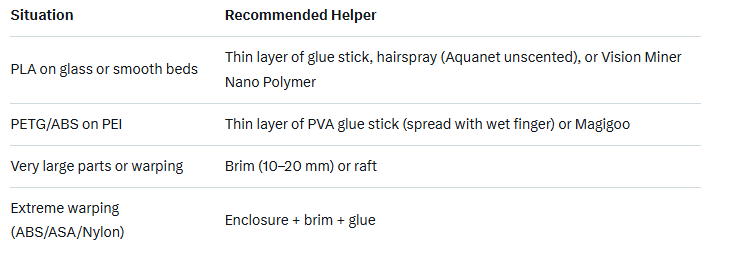
4. Use Adhesion Helpers When Needed
5. Temperature Tweaks
1.Increase bed temperature 5–10 °C higher than usual for the first few layers (e.g., PLA 65 °C instead of 60 °C).
2.Slightly increase nozzle temperature for the first layer (+5–10 °C) → better flow and squish.
6. Mechanical & Environmental Fixes
1.Eliminate drafts (cover printer or add enclosure panels).
2.Keep filament dry — wet filament causes warping and poor adhesion.
3..Add a brim or mouse ears on corners for big parts.
4..Use an adhesion promoter like Magigoo, 3DLac, Dimafix, etc. for problem filaments.