
Aluminum die casting is a high-precision metal casting process that forces molten aluminum alloy under high pressure into a reusable steel mold (called a “die”). The metal solidifies rapidly, producing complex, thin-walled, high-strength parts with excellent surface finish and tight tolerances.It is one of the most popular and cost-effective manufacturing methods for producing large volumes of aluminum components.
Key Steps in the Aluminum Die Casting Process
1.Die preparation
The two halves of the steel die are sprayed with a lubricant/release agent and closed.
2.Injection
Molten aluminum (typically kept at 650–720 °C / 1200–1330 °F) is ladled or automatically poured into a shot sleeve and then injected into the die cavity at very high pressure (usually 10–175 MPa / 1,500–25,000 psi) using a hydraulic plunger.
3.Solidification
The aluminum cools and solidifies extremely quickly (often in seconds) because the steel die pulls heat away rapidly.
4.Ejection
The die opens and ejector pins push the casting out.
5.Trimming
Excess material (flash, runners, overflows) is trimmed off, usually with a trim die or saw.
Two Main Variants
Cold-chamber die casting → Most common for aluminum. The metal is ladled into a cold shot sleeve for each shot (prevents the plunger from dissolving in molten aluminum).
Hot-chamber die casting → Used for lower-melting alloys (zinc, magnesium). Not suitable for aluminum because aluminum would attack the steel plunger and gooseneck.
Common Aluminum Alloys Used
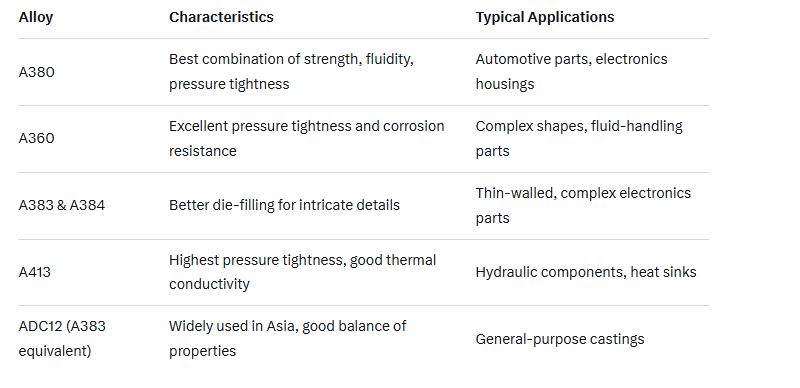
Advantages of Aluminum Die Casting
1.Extremely high production rates (hundreds to thousands of parts per hour)
2.Excellent dimensional accuracy and stability (±0.002 in/in is common)
3.Thin walls possible (down to ~1 mm / 0.040 in)
4.Smooth surfaces (often no secondary machining needed)
5.High strength-to-weight ratio
6.Good corrosion resistance (especially with proper alloy/coating)
7.Recyclable and environmentally friendly (scrap is routinely reused)
Limitations
High initial tooling cost (steel dies are expensive)
Generally only economical for medium-to-high volumes (>~1,000–5,000 pieces)
Porosity can occur if process parameters are not controlled (can affect pressure tightness and strength)
Limited to relatively small-to-medium sized parts (typically<15–20 kg / 33–44 lb)
Typical Applications
Automotive: transmission cases, engine brackets, wheels, structural components (e.g., Tesla Model 3/Y body structure uses large aluminum die castings)
Consumer electronics: laptop and phone frames, heat sinks
Appliances: washing machine tubs, power tool housings
Telecommunications: antenna mounts, router housings
Aerospace & defense components (when secondary machining and heat treatment are applied)
In short, aluminum die casting is the go-to process when you need strong, lightweight, complex aluminum parts in high volumes with excellent finish and precision.